


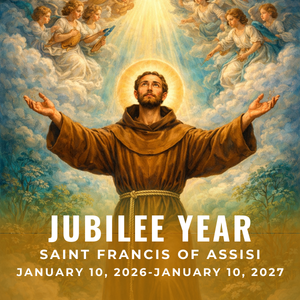
"Hold fast to the memory of our father and brother, Francis for the praise and glory of Him who made him great among us and glorified him in the sight of the angels. Pray for him, as once he asked us, and pray to him that God may make us sharers with him of his holy grace."
WELCOME
We are honored to welcome you as we celebrate the Jubilee Year of our patron saint, St. Francis of Assisi. This special year invites us to reflect on his life of simplicity, humility, and joyful devotion to Christ. As you visit, we invite you to prayerfully explore the sacred artwork and relics displayed throughout our church. Each piece tells a story of faith and offers a glimpse into the spiritual legacy of St. Francis and St. Clare—saints who continue to inspire the Church and the world. In this Jubilee Year, proclaimed in communion with Pope Leo XIV, may your time here be one of renewal, peace, and deeper encounter with Christ.
Welcome, and may the Lord give you peace.
JUBILEE YEAR ST. FRANCIS OF ASSISI AT SAINTS FRANCIS & CLARE OF ASSISI CATHOLIC CHURCH
SAINT FRANCIS OF ASSISI
St. Francis of Assisi has long been one of the most popular saints in the Church. He was born in Assisi, Italy in 1181, the son of Pietro and Pica di Bernardone. His father was a member of the new merchant class and made money in the textile trade. As a youth Francis spent money lavishly and partied well. Serious illness brought him to see the emptiness of his life. His conversion reached a climax when he embraced a leper he met along the road. Soon thereafter he began to care for the sick and gave his money to the poor.
One day, while he was praying in the run-down church of San Damiano, he heard a voice coming from the crucifix that said, "Francis, go and repair my house, for it is nearly falling down. At first, he thought God wanted him to repair the church building. But soon he realized that God wanted him to bring to people the transforming power of the gospel. Francis committed himself to prayer and to actively preaching the gospel. He really believed what Jesus said, "Announce the kingdom! Don't possess gold or silver or copper in your purses, no traveling bag, sandals, staff."
During the last years of his relatively short life (he died at 44) he was half-blind and seriously ill. Two years before his death, he received the stigmata, the real and painful wounds of Christ in his hands, feet and side. He died October 3, 1226 and was canonized two years later. His feast day is October 4.
Welcome, pilgrims, to St. Francis & Clare of Assisi as we joyfully celebrate the Jubilee Year of St. Francis of Assisi. As you journey through our parish, we invite you to pause, pray, and reflect upon the sacred works and witness displayed here—artwork, relics, and symbols that reveal the life, humility, and enduring spirit of St. Francis. May these holy expressions draw you closer to Christ and inspire you to walk more fully in faith, peace, and care for all creation.
sacred artwork and relics
DOWNLOAD/PRINT SACRED ARTWORK AND RELICS BROCHURE
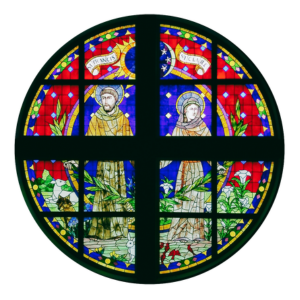
1. east rose stained glass window
As you proceed up the main walk to our church, you are welcomed by our iconic East Rose Stained Glass Window, which beautifully depicts the spiritual bond of Saint Francis & Saint Clare of Assisi.
Inspired by events beginning on Palm Sunday in 1212, the window recalls the moment when 18-year-old Clare of Assisi courageously left her noble life to follow Christ. Kneeling before St. Francis at the Portiuncula, she renounced her wealth and dedicated her life fully to God, becoming the first member of the Poor Clares, with Jesus as her spiritual Bridegroom.
The imagery weaves together key Franciscan symbols: St. Francis preaching to the birds, reflecting his deep love for all creation, and palms offered to St. Clare, symbolizing her Palm Sunday conversion and complete surrender to God. Together, these images invite all who enter to reflect on radical faith, humility, and joyful discipleship. Throughout the artwork, you will also find the Wolf of Gubbio, Brother Sun representing St. Francis, Sister Moon representing St. Clare, abundant animals honoring God’s creation, and white lilies as a sign of purity.
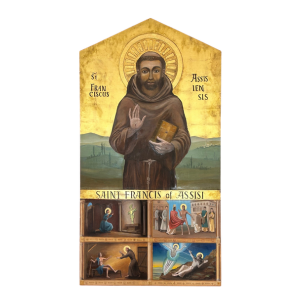 2. icon of saint francis of assisi
The icon to Saint Francis is decorated this year with gold bunting and flowers, and includes images of Saint Francis before the San Damiano Cross, the renunciation of worldly goods, the healing of a cripple, and receiving the stigmata. The flowers to honor Saint Francis can be thornless red roses for love of creation, white for purity, yellow for encouragement of faith, purple for his stigmata. Other flowers are lilies for purity, wild violets for modesty, daisies for simplicity and sunflowers that follow the sun, follow the light of Christ.
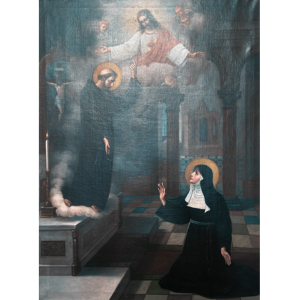
3. painting of saints francis & clare of assisi
Our painting of Saints Francis & Clare of Assisi in the south east corner of the church is also adorned with flowers and gold bunting. This painting originally belonged to the Sisters of Saint Francis in Oldenburg, and we are honored to display this work of art.
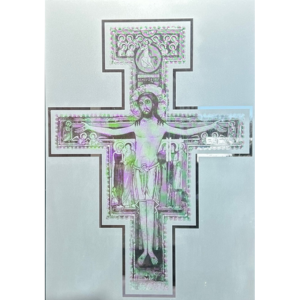
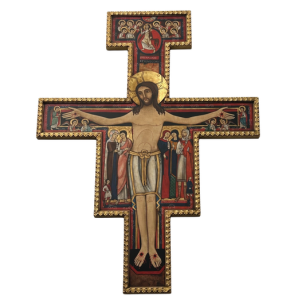
4. & 5. san damiano crosses
There are two San Damiano Crosses—one in the glass of the south door of the church that leads out to the Resurrection Garden, and a large one in the Blessed Sacrament Chapel. Christ spoke to Saint Francis 821 years ago from the San Damiano Cross, telling him to “rebuild my church”.
DOWNLOAD/PRINT THE SAN DAMIANO ARTICLE
THE SAN DAMIANO CROSS IMAGES AND MEANING
The largest figure is Jesus Christ, represented both as wounded and strong, standing upright and resolute. The bright white of the Lord's body contrasts with the dark red and black around it and, therefore, accentuates the prominence of Jesus. He projects the life of divine nature in a body pierced by nails in the hands and feet, by the crown of thorns on his head, and by the soldier's lance in his side. The representation contrasts with the regal Christ portrayed on the cross in earlier centuries and the crucified Christ depicted generally throughout the Church since the beginning of the 14th century.
The next largest figures are five witnesses of the crucifixion and witnesses of Jesus as Lord. On the left side are the Virgin Mary and St. John the Evangelist, to whom Jesus entrusted his mother. On the right side are Mary Magdalene: Mary, Mother of James; and the centurion who in Matthew's Gospel account asks Christ to heal his son. Both Mary and Mary Magdalene have their hand placed on their cheeks to reflect extreme grief and anguish. The first four witnesses have halos because they are saints who gave their lives for the Lord.
The three smaller figures are represented as witnessing the crucifixion. On the lover left is Longinus, the traditional name of the Roman soldier who pierced the side of Jesus with a lance. In the lower right is Stephaton, the traditional name for the soldier who offered Jesus the sponge soaked in vinegar wine.
Peering over the left shoulder of the centurion is a small face. A close look reveals the tops of the heads of three others beside him. This represents the centurion's son who was healed by Jesus and the rest of his family to show that "he and his whole household believed." (John 4: 45-54)
At both ends of the crossbar are six angels are represented as marveling over the event of the crucifixion. Their hand gestures indicate they are discussing this wondrous event of the death and calling us to marvel with them.
At the foot of the cross there is a damaged picture of six figures, two of whom have halos. In accordance with the traditions of the day, these six are the patrons of Umbria, the region surrounding Assisi: St. John, St. Michael, St. Rufino, St. John the Baptist, St. Peter, and St. Paul.
On the top of the cross, one sees Jesus now fully clothed in his regal garments and carrying the cross as a triumphant scepter. He is climbing out of the tomb and into the heavenly courts. Ten angels are crowded around, five of whom have their hands extended in a welcoming gesture to Jesus, who himself has his hand raised in the form of a greeting.
At the very top of the cross in the Hand of God with two fingers extended. This is to be understood as the blessing of God the Father on the sacrifice of his Son. On the right side of the picture next to the left calf of Jesus, there is a small figure of a fowl. Some art historians have interpreted it to be a rooster, (Jesus' denial by Peter); other commentators see it as a peacock, a frequent symbol of immortality in Early Christian art. Along the lower right side of the shaft, there is a small animal, possibly a cat.
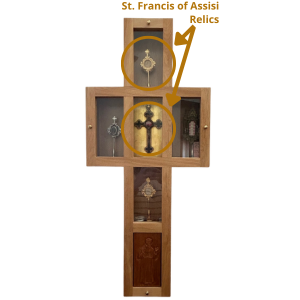 6. relics in the blessed sacrament chapel
Our reliquary in the Blessed Sacrament Chapel, holds several relics, including relics of Saint Francis and a relic of Saint Clare. Veneration of these holy relics brings us closer to the saints, and to Christ himself.
RELICS IN THE BLESSED SACRAMENT CHAPEL PAMPHLET
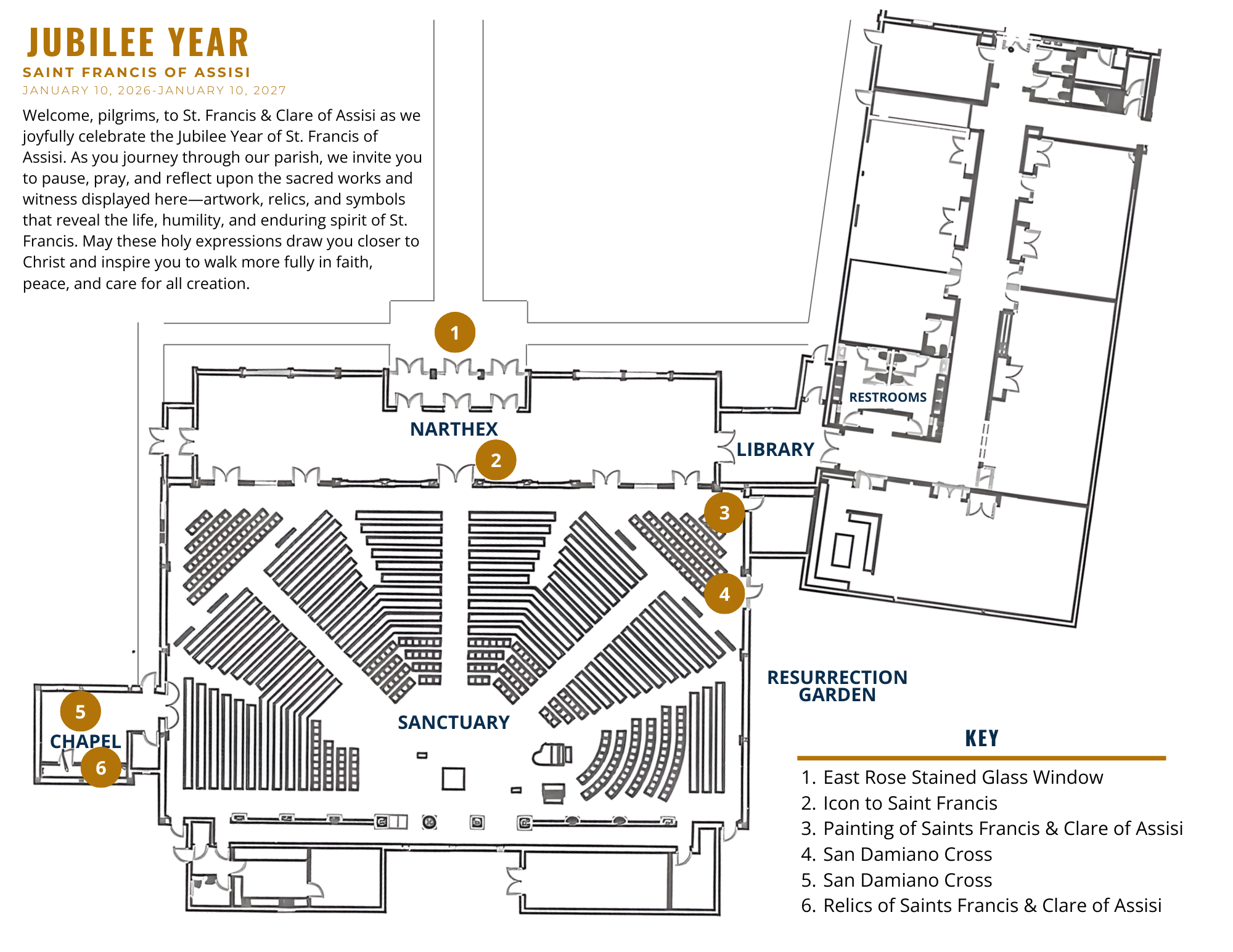
JUBILEE MAP
This map is designed to guide you through the sacred artwork, relics, and devotional displays located throughout our church and campus. Each piece reflects the rich Franciscan heritage of our parish and honors the faithful witness of St. Francis and St. Clare. As you follow the map, we invite you to pause at each location, reflect on the spiritual significance of these sacred expressions, and allow their beauty to draw you more deeply into prayer.
TOUR GROUPS
Pilgrim groups wishing to visit Saints Francis & Clare of Assisi during the Jubilee Year of Saint Francis of Assisi are warmly welcomed. To arrange a guided tour and prayerful visit highlighting the church’s sacred artwork, relics, and Franciscan devotions, please contact Very Rev. Stephen W. Giannini, V.F., Pastor, to schedule your group’s visit. We look forward to welcoming you as you journey in the spirit of St. Francis.
Very Rev. Stephen W. Giannini, V.F., Pastor, 317-859-4673 ext. 111 or This email address is being protected from spambots. You need JavaScript enabled to view it.
FOR MORE INFORMATION
| Contact |
Parish Office |
|---|